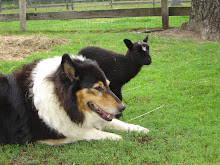
Today is our first "Blog-Anniversary"! Hard to believe one year has gone by since my first post. I can still remember posting "Welcome to our Peaceable Kingdom" and wondering if anyone would read it. I didn't dare hope for a comment :) THANK YOU to all of you who read the blog, take the time out of your busy schedules to leave comments and for all the wonderful tips and tidbits you have shared with me over the last year. I am so happy to have met all of you and learned about your lives and how you live. I can only hope that year #2 is as good as the first :)
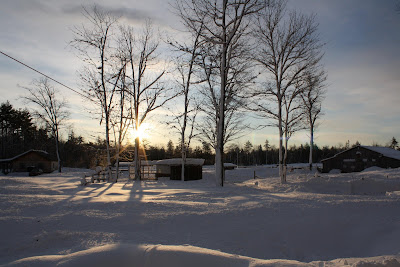
 It truly feels like spring in the Northeast today. The thermometer says 45 degrees....yoohoo :) This jet was the only thing in the sky all day.
 This is always a good sign that spring has arrived. We have five seasons in Maine. Spring, Summer, Fall, Winter and MUD season. It's doesn't get to be a real mess unless it's 50 everyday for a week. Then the mud is a foot deep. With the gentle or sometimes not so gentle March winds and a slow-w-w-w-w melt, it dries up fairly quickly.
 The ducks are quite happy. I couldn't get close enough to get a real good shot of them but they are definitely out of their "home territory" looking for a puddle. When they see me, they run for cover, and then struggle to climb the snowbank because they are in so much of a hurry. They are a riot to watch :) ** could someone please tell me how to post photos so viewers can click on them to enlarge them?**
"Ribbon"

"Lace"
These gals should have wide load signs on their backsides :) I expect they will both have at least twins or triplets. Delilah was not feeling very photogenic and refused to have her picture taken. She's not as large as these two but twins wouldn't surprise me. They are all very good Mom's and babies should be arriving any day now. I can hardly wait :)
All the pygoras are in full fleece. It is soooo soft and fluffy. Tomorrow is shearing day. Everyone will get a haircut, feet trimmed, vaccinations and de-worming. I'll be sure to post before and after photos.


 "Gus" in the sunshine.
 This is one half of my basement. It's a wonderful place to process sheep hides and for storing winter vegetables. It's a 4 foot frost wall design so I have to stoop a little as I'm 5'. I'm going to get a rolling mechanics stool so I can sit and push myself around. I have milk crates set up on the other side with plywood on top with heavy plastic over the plywood. These serve as my drying tables. The house is 68 feet long so I have quite a good amount of space.


.jpg)

 I had the pleasure of meeting a lovely lady, Jane, several years ago who is extremely knowledgeable about dyeing wool with natural plant dyes. I had the pleasure of taking part in one of her Natural Dye Classes and was amazed with whats available on my own farmland that produces wonderful dyes for my wool.
 This color is from a plant called Madder. This is a perennial plant that grows quickly and needs room to spread out. It's usually a year or two before you can harvest from this plant. The roots are what is used to produce the dye. You can achieve many variations of this beautiful red/orange color by using a different mordants as well as different fibers.
 This color was achieved by using leaves from the woad plant. Woad is a biennial, hardy to zone 3. It is a spreading type plant with flowers stalks that grow 2 t0 3 feet. Woad IS the source of blue dyers in cold climates. In mild climates, woad is evergreen. Otherwise, it freezes down to the ground. In the spring, woad flowers are as early as daffodils in the same beautiful yellow color.
 This color was achieved by using the tops of Goldenrod. It grows prolifically in the northeast. The tops of four plants can dye 4 ounces of wool. One plant blooms 3 to 4 weeks and you can see fields of goldenrod blossoms from July to October.
 This lovely yellow is produced by using the shoots of the Dyer's Broom shrub. This terrific shrub is hardy to zone 4. One plants needs about 4 square feet of space. It blooms early in the spring with tons of little yellow blossoms and continues to bloom throughout the summer. I love to give this shrub a "haircut" in the fall. No matter how much you cut it back, it thrives the following spring. It starts throwing out new shoots as early as the woad flowers start popping out.
 I'm making progress on my new woven shawl. I am using this gray wool yarn from our sheep, Freida, for the warp.
  I overdyed three skeins of this gray searching for a rich, burgandy color. I used a dye called crimson and was very happy with the results. It is exactly what I was looking for.
  I think these two colors look wonderful together and will make a beautiful shawl.
 The photo below is my warping board. For those that don't know, this is where I wind on the yarn in a specific pattern for whatever project I'm going to weave. I wound on the first course of gray yesterday. The burgandy is dry today so I can wind on the rest.
 As always, my constant companion and best buddy is by my side, making sure all is well and catching a few winks. Life just wouldn't be good without my Banjo.