Sunday, February 22, 2009

~ Dreary Sunday........

It's a dreary, damp day here in the Northeast. We have a snowstorm moving it's way up the coast, but it started as freezing rain or just plain rain in some areas. We were fortunate with the storm we had during last week and only picked up another 6 inches or so. I'm hoping we are just as lucky this time :)
(Thursday's storm)
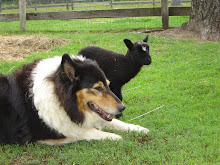
Things have been rather quiet here the last couple of days. Not much in the way of "farm" news. Even Danny Dog is bored :) He's laying on top of a round bale. He's waiting for a cat to come out of the barn so he can chase it! Our female is in heat so we have a stray Tom cat or two around. Danny just loves his job of running them off. He and Banjo spend a lot of time "playing" while we do chores. They are always under your feet, which is right where we want them :)

I spent the last two evenings knitting and finished my magic stripe socks. This is fun yarn and I will definately make another pair. The great thing is they fit. I didn't try to match the yarn for the second sock. I really didn't care if the stripes matched or not. I think they are cute just the way they are :)

I've already picked out my next knitting project which will be a pair of fingerless gloves for a special friend so the socks will have to wait a little bit. It's great to have these fun projects to look forward too.

I've done a little more spinning of the Gotland lambswool - I hope to have that 4 ozs spun up this week. Not sure what I'm going to make with that.

Hope your all having a nice sunday :)

Thursday, February 19, 2009

~ Colorful memories.........

When I was a young child in the early 60's, I remember how much I loved going to my maternal Grandmother's house. She lived in a small mobile home in a small NH town. In her living room was a double window facing a small clearing. The rail road tracks were on the far edge of the clearing. I could hear the train coming for what seemed like a long ways away and would stand in that window, waving to the train.
In front of her window was a low table. On that table was an amazing assortment of plants. I remember mostly African violets in every color and cacti in many species and colors. I can hear her telling my brother and I "don't touch the cactus, it will prick your finger!". Of course, we were so tempted and touched that cactus spike and did get a pricked finger :)

She had an incredible green thumb. She lovingly tended her plants and her home. Sadly, she passed away when I was just 12 but I have wonderful memories of her that I carry with me. One of them is our shared love of African violets (purple ones especially). I have many in my home. Some of them are over 20 years old. They continue to thrive and blossom, much to my amazement. No matter where I place them in any house I live in, they do well. I always have two or three that are blossoming at the same time all through the year. They add such color and brightness to my home. I like to think that's a part of her that lives on through me.
No cacti in my house - I don't do well with succulents of any kind. They always die......that and the fact I never did learn to keep my fingers away from the prickers :)

Wednesday, February 18, 2009

Tuesday, February 17, 2009

Canning / Preserving meat


I like to think I'm a person that has a reasonably positive outlook on life but like many people in our country right now, I am concerned about what's to come in the times ahead. I try not to take for granted the things in my life that enable my family to live comfortably such as electricity. I don't dwell on the subject but I do think about what we would do without it more often that I used to. We have been researching windmills for quite some time now and we are making progress with that endeavor. That in itself would eliminate our dependence on our local electric company. Our biggest use of electricity on the farm other than lighting is our water pumps and our freezers. We have three of them, full of meat and vegetables.

The whole point of this topic is this: If we should find ourselves without electrical service for any reason, what would we do?

We could use other sources for lighting and we have a hand pump that connects to any of one of our four well points to draw water. My biggest concern is my freezers. What would I do with all that meat? I've been talking with my Dad and Mom about how meat was preserved when they were children. Not everyone had electricity in the 1930's - meaning no freezers. Meat was often dried, smoked, any often canned. Duh.........I never gave canning meat a thought until our conversations. Now I can't stop thinking about it. It would be a huge undertaking to can 400lbs of beef but not impossible. I've read all three of my canning and "Putting Food By" books in the last two days about canning different meats.

I can't explain my excitement learning about this process - it's one more way that we can rely on ourselves. I certainly do not want to go without electrical power but it's a big relief for me to know that I can continue to preserve everything I raise here for my family should that happen.
I have a beef headed for the freezer and will talk to my butcher about different cuts that will work better for canning.
Do any of you can meat? Have you been happy with the end result? I'd to hear what you think about this process.

Monday, February 16, 2009

~ Monday hodgepodge...........

Life is fairly quiet here at the moment. That is a good thing. The weather has been pleasant and we have finished several small barn projects. Now we are in a holding pattern until spring arrives other than babies will be here soon. Everything is ready for the mama goats to give birth. I love babies :)

This is Ribbon and Lace. They are Pygora goats ( pygmy x angora) and are both bred to our caramel colored Angora, Amos. This combination gave us chocolate babies with caramel points last year. I'm hoping to get at least one light colored kid this year. I have one other white doe that is due as well. Baby goats are so curious right from the get go - it's one of my favorite times of the year.
I followed the recipe for no-knead artisan bread in the new Mary Janes Farm magazine. The first batch did not come out well. The bread was very heavy and did not rise as it should have. The second time I made sure I measured the flour and water that you add each day exactly for what was called for. The dough was much thinner and stickier. I used two cups of the "mother" on Saturday and added salt, honey and flour. Let it rise in a pan on my warming shelf all day and baked before dinner. It was yummy! It really takes only a minute or so each day to add the flour and water. I'm going to try again this week and add herbs and garlic. I like the fact it does not need yeast in order to rise, the recipe doesn't call for sugar and you do not have to knead the dough. That and I can add anything I like to the dough before I bake it. My family was so anxious to eat it that I couldn't get a photo before they cut it. It looked similar to the photo above. We had warm bread with home made, fresh butter. I can only do this once a week. None of us need any more bread than that!
I've been slowly working on the new shawl. I've decided to over dye some of the gray yarn an elderberry color. I'm going to use the elderberry with the natural gray to weave a shawl using the pattern in the shawl below that I made a couple of years ago. I think the colors will complement each other well. I hope to get the yarn dyed this coming weekend. I'm anxious to get started.

I dusted off my spinning wheel and found time twice this past weekend to do some spinning. I'm spinning up four ounces of Gotland lambswool. Gotland sheep come from the Swedish Island of Gotland. They have long, lustrous curly fiber and its a dream to spin. Gotland fiber only comes in shades of gray from light to dark. Gotland sheep are not imported into this country. The American Gotland Sheep Society was founded in 2008 by a group of people interested in Gotland sheep and they began an artificial insemination program, inseminating specific foundation ewes with Gotland Ram semen. When the association was formed, less than 50 crossbred Gotland sheep existed in this country. If your interested in learning more about these great sheep, go to http://www.americangotlandsheep.com/.

Gotland lambswool

Tyler has a one hour Karate class each week and I try to have a "pocket project" to take with me. This week it's magic stripe socks. I have the hardest time making socks for myself - the patterns are always too big. I have a Tylerfarm Simply sock pattern that a I sell with my finn yarn and I re-worked the number of stitches and started this pair. I was so anxious to get one done and surprisingly - it fits!! The second is about half done. Now I'm anxious to wear them. I don't normally like to knit with this fine sock yarn, I get impatient - but it was a gift and I love the colors. I'm finding as I knit more, I'm getting more proficient and projects aren't taking so long.

~Wishing you all a great week ~

Saturday, February 14, 2009

Friday, February 13, 2009

~ Cheese.......

I purchased this great cheese making book awhile ago and have been so eager to begin but just haven't been able to find the time. I finally got around to ordering all the items necessary to make basic cheese and they arrived yesterday. I'm hoping that I can start my first batch on Sunday.

Cheese making isn't terribly difficult, especially soft cheeses, but very time consuming. Much of your time is spent standing by the stove, watching the thermometer and letting it stand covered, draining, etc.

My first cheese is going to be cream cheese. We all love it and home made cream cheese will keep in your refrigerator for at least two weeks. I can add fresh herbs of my choice or any other ingredients that we enjoy. If that is a success, cottage cheese is next on the list and it goes on and on :)

According to my book and what I've read on the net, in the cheese making world, raw milk is seen as the gold standard ( I sure have plenty of that). Raw milk contains all of the micro flora and enzymes that the animal has ingested from grazing in it's own unique environment. It's also full-flavored milk that makes rich-flavored cheeses. Completely natural -

When using pasteurized milk, you have to add calcium chloride during cheese making if the milk is homogenized. This is due to the fact that the milk will have fewer enzymes and will have a flatter taste.

According to my book and I quote "in essence, it could be said that raw milk cheeses are the direct descendants of the cheese makers of antiquity". I find the history of cheese making very interesting. I can only hope mine will be edible :)

Of course, when dealing with raw milk or milk in general, cleanliness and safety are of the utmost importance. I have utensils that will only be used for cheese just as I have items that are only used for milking my cow.

It takes approximately 4 days from start to finish to make cream cheese. Wish me luck!